

Eliminate 50/60 Hz noise and harmonics without filtering.
Hum Bug 50/60 Hz Noise Eliminator
A New Solution
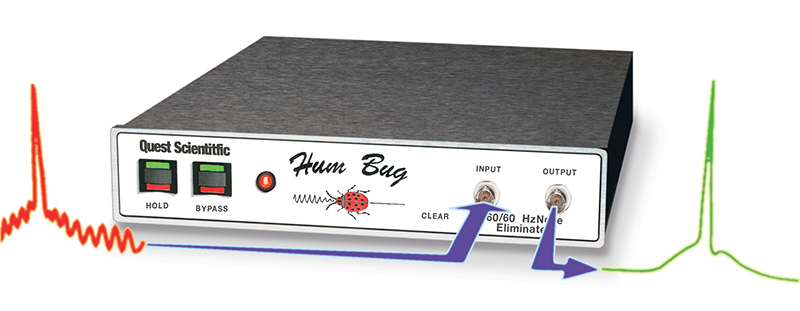
Quest Scientific is proud to introduce the Hum Bug — a new approach to Noise Control. This is a powerful new technology for canceling electrical interference in real-time, avoiding all of the traditional problems associated with notch filters. The Hum Bug constructs a replica of noise present on the input signal and continuously subtracts this replica from the signal as it passes through the instrument. It performs this function in the presence of biological activity even when noise characteristics evolve over time.
Advantages
The Hum Bug is not a filter. It does not create phase delays, amplitude errors, DC shifts or waveform distortion. Simply connect it between your preamplifier and any analysis equipment and it will automatically eliminate 50/60 Hz noise and harmonics with frequencies up to several kHz. Noise is eliminated without altering the signal of interest even when frequencies within the signal overlap with noise components. No settings or adjustments are required.
Eliminates Electrical Interference
- Simple 50/60 Hz Sine Waves
- Mixtures of 50/60 Hz Harmonics
- Noise Spikes from Dimmers
- Complex Noise from Flourescent Lamps
No Waveform Distortion
- No Frequency Loss
- No DC Voltage Shift
- No Signal Attenuation
- No Phase Error
Specifications
Physical
Standard steel instrument box with cast aluminum base.
- Dimensions:
6.5″ x 7.5″ x 1.3 | 32.2cm x 18.1cm x 3.1cm - Weight
2.8 lb. (1.3 kg) - Power
115-120 VAC at 60 Hz
230-240 VAC at 50/60 Hz
Input Voltages
- Input protection: 50 volts peak-to-peak.
- Maximum input signal recognized by the adaptor: 5 volts peak-to-peak.
- Maximum noise amplitude for complete cancellation: 1 volt peak-to-peak.
Frequency Response
- Input to output: DC to greater than 500 kHz.
- Hz and harmonics cancellation: 50/60 Hz to 4 kHz.
Controls
BYPASS: halts noise cancellation by routing input directly to output.
HOLD: suspends adaptation to evolving noise characteristics.
CLEAR: clears the noise replica.
Display
LED indicates changing noise levels:
GREEN: decreasing amplitude of the noise replica.
RED: increasing amplitude of the noise replica.
 Powered by Bioz